
Assessing the condition of soil might soon be as easy as consulting the nearby microbes. Drones or satellites could interpret their responses, which would manifest as varying hues when stimulated by factors such as nutrient levels or pollutants.
As they can readily be modified to generate molecules under specific conditions, bacteria are extensively used used as sensors However, examining their answers typically demands a microscope and patience.
This could soon be accomplished by taking pictures with a drone and waiting for half a minute, since MIT researchers have developed a sensing system wherein bacteria emit light at specific wavelengths upon detecting a targeted substance.
The system seems versatile enough to detect basically any molecule, chemical or bacteria, good or bad. By adding two different bacteria, it could, in effect, make fields glow red when pollutants take hold and green when nutrients are high.
"So, it might respond to metals or radiation or toxins in the soil, or nutrients in the soil, or whatever it is you want it to respond to," says Christopher Voigt, biological engineer at MIT.
"Then the output of that would be the production of this molecule that can then be sensed from far away."
The group employed specialized cameras mounted on drones Or structures for scanning soil samples monitored by genetically modified bacteria. The specimens with the desired substance stood out, producing a signal up to twelve times more intense than those without, detectable from as far as ninety meters (two hundred ninety-five feet) distant.
The luminescence would not be noticeable without assistance – it operates using hyperspectral cameras These gadgets can identify numerous wavelengths within both visible and infrared light spectra, assessing their quantities across each pixel in an image. This capability enables them to discern subtle shifts in colors that remain undetectable not only to other tools but also beyond the perception of the human eye.
The researchers designed bacteria to generate 'indicator' compounds detectable by hyperspectral cameras. Initially, they conducted quantum mechanical simulations on 20,170 metabolic products to identify the optimal choices for this purpose.
The top hyperspectral reporters (HSRs) are distinguished by having highly distinctive spectra that can be generated using the least amount of enzymes, authors write In their document outlining the research.
Ultimately, they narrowed it down to two promising candidates: a pigment referred to asصند biliverdin , which can give bruises a green tinge, and a bacteriochlorophyll , which certain microbes utilize for photosynthesis. The genes encoding biliverdin production were genetically inserted into a soil bacterium known as Pseudomonas putida while an aquatic microbe known as Rubrivivax gelatinosus acquired the capability to synthesize bacteriochlorophyll.
These outputs were connected to sensor circuits within the bacterial genomes — in this instance, designed to identify neighboring bacteria. However, fundamentally, the trigger could be virtually anything, such as chemicals present in polluted soil.
One of the great things about this technology is that you can easily connect and use whatever sensor you prefer, says Yonatan Chemla, an environmental microbiome engineer at MIT, stated, "There’s no reason why any sensor shouldn’t work well with this technology."
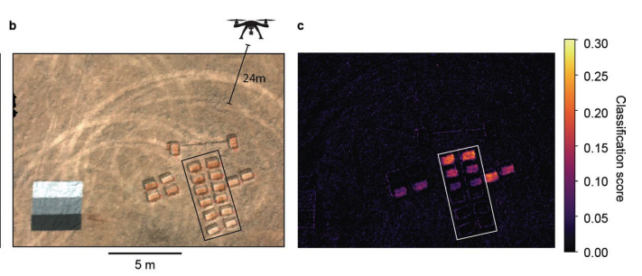
To examine this concept, the group positioned specimens of earth or sand inside exposed containers, with certain ones holding concealed disks as the focus objects. Drones equipped with hyperspectral cameras or rooftop-installed units were capable of capturing photographs spanning several hundred to thousands of square meters within just thirty seconds.
Indeed, the containers holding the targets emitted strong luminescence, markedly differing from the control specimens.
The researchers acknowledge funding from the US Department of Defense as well as the Israeli Ministry of Defense.
Over the last three years, we have dedicated significant effort to grasping the regulatory environments and addressing safety concerns, as well as identifying the risks and benefits associated with this type of technology. says .
Although the security and guidelines surrounding these systems remain unresolved, the group asserts that the technique holds potential for continuous ecological surveillance.
"Microbial sentinels offer benefits as field sensors. These organisms can cover large regions and react to distinct stimuli; they remain active without requiring electricity," the document states. authors write .
Furthermore, HSRs can be captured during daylight hours under normal lighting conditions and distinguished in spectrally intricate settings such as open terrain, vegetation, and urban constructions.
The study was published in the journal Nature Biotechnology .
Comments
Post a Comment